Tania Boemio
Languages and New Technologies
Francisco Theodosiadis
28, October, 2009
The Neapolitan Language
Italian is known to be the official language of Italy and one of the official languages of Switzerland. The Italian language is also spoken in Northern and southern America and including other European countries. The Italian language is of the Italic Indo-European group of languages. Italian is based on the Latin language which has many similarities. During the period of the rise of the Italian language, numerous Italian dialects were introduced. The beginning of these dialects reflects upon the political and cultural aspect of the several regions in Italy. The major dialects are the Northern dialects, which include the provinces of Emilia-Romagna, Tuscany and further more to the south like Umbria to Sicily which are known as the southern dialects of Italy.
Historically, during the 10th century Italian documents were written and inspired by the several Italian dialects. The Tuscan dialect began to be the majority dialect spoken throughout the 14th century. During this time, three major literary artists reflected on the Italian culture and traditions. These artists are Dante, Petrarch and Boccaccio. They all influenced the Florentine culture and dialect. Dante Alighieri, who wrote “La Divina Comedia”, attacked the Italian literature. Then there was Francesco Petrarca in which he has written love poem which has tremendously influenced the Italian literature. Afterwards, Boccaccio who wrote “the Decameron” was manly focused on the Italian writing. During the 16th century, “Venetian Pietro Bembo set out his proposals for a standardized language and style”. He wanted it to reflect Florence’s Petrarca and Boccaccio’s works.
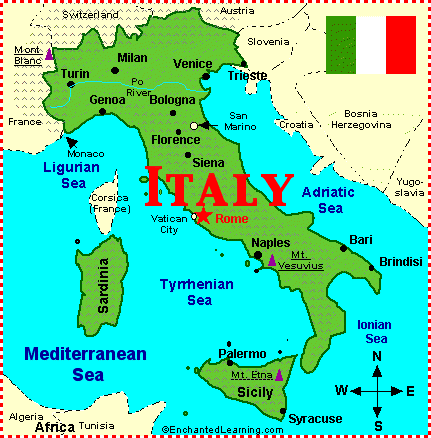
One of the many dialects commonly known is the Neapolitan dialect. Neapolitan also known as Napulitano, is an Italo-Dalmatian language which is generally spoken in the region of Naples and other southern regions such as Campania, Northern Calabria and most of Molise. Approximately, seven million people in Italy speak Neapolitan. This dialect is spoken in places like “Irpino, Cilentano, Ascolano, Teramano, Abruzzese Orientale Adriatico, Abruzzese Occidentale, Molisano, Dauno-Appenninico, Garganico, Apulo-Barese, Lucano, and Cosentino”, which are all across Naples. The Neapolitan dialect took part all through the union of the Kingdom of Naples and of the Two Sicilies. King Alfonso decided to group both Naples and Sicily together as a whole because it shared common affairs. As described in a text, “The language as a whole has often fallen victim of its status as a language without prestige”. The Italian language and the Neapolitan dialect have similarities and differences in the grammatical aspect, and for some it isn’t quite apprehensible. The Neapolitan dialect was previously similar to the Italian language, but it has instantly elaborated from the Vulgar Latin language. “This language is characterized by seven sounds: í, é, è, à, ò, ó, ú, to these it must be added a schwa (ə) sound characteristic of unstressed vowels”. One of the differences of the Neapolitan dialect is the pronunciation of the letter D. It sounds like the letter R. For example, “vede” which means to see is pronounced as “vere”. With the letters “nd” it changes to “nn”; for example, “quando” and “quanno” which means when. Another example is nessuno, which means no one, is pronounced as nesunn.
Before Naples aligned itself as an Italian province, in the 9th century it was distinguished that it was a Greek speaking province. Because of this, the Greek language has also influenced the languages; by using Greek words and turning them around to make it sound more Neapolitan. This dialect has also considerably persuaded the Spanish language specifically in Buenos Aires, Argentina. The Neapolitan dialect has definite articles, such as La for feminine, Lo for masculine and Li for plural, but the words are usually shortened at the end. The indefinite articles such as an or a, is “na” for feminine and “nu” which is short for nun, is masculine. Adjectives also change. The indefinite article for “questo” which means this is “chist” or “chill” which means that or he depending on your type of phrase.
What makes the Neapolitan language so unique like it says in one text is that it has, “a rich literary, musical and theatrical history”. It is one of the hardest Italian dialects, along with the Sicilian dialect to learn. As of 2008, the Neapolitan language was recognized as a language. Many had strong opinions on this dialect by saying that it was a “low-class language”. This idea was to promote the Neapolitan dialect across Italy and to not forget its history, culture and traditions.
References
· Colacino, Carmine. Neapolitan: Dialects and Languages. The Neapolitan Language and the Romance Family of Languages. 2008. <http://www.duesicilie.eu/spip.php?article4>
· Name unknown. Neapolitan language. 2009. <http://en.wikipedia.org/wiki/Neapolitan_language>
· Name unknown. Neapolitan language. Encyclopedia, 2009. <http://www.absoluteastronomy.com/topics/Neapolitan_language >

No comments:
Post a Comment